
Domain resolution paths

Domain Takedown vs UDRP: Which Route Fits?

Operational domain takedown, UDRP, and URS can all address harmful domains, but they do not target the same problem or produce the same remedy.

The right route depends on what the domain is doing, what can be demonstrated, whether urgent customer harm exists, and whether the desired outcome is source disruption, suspension, or transfer.
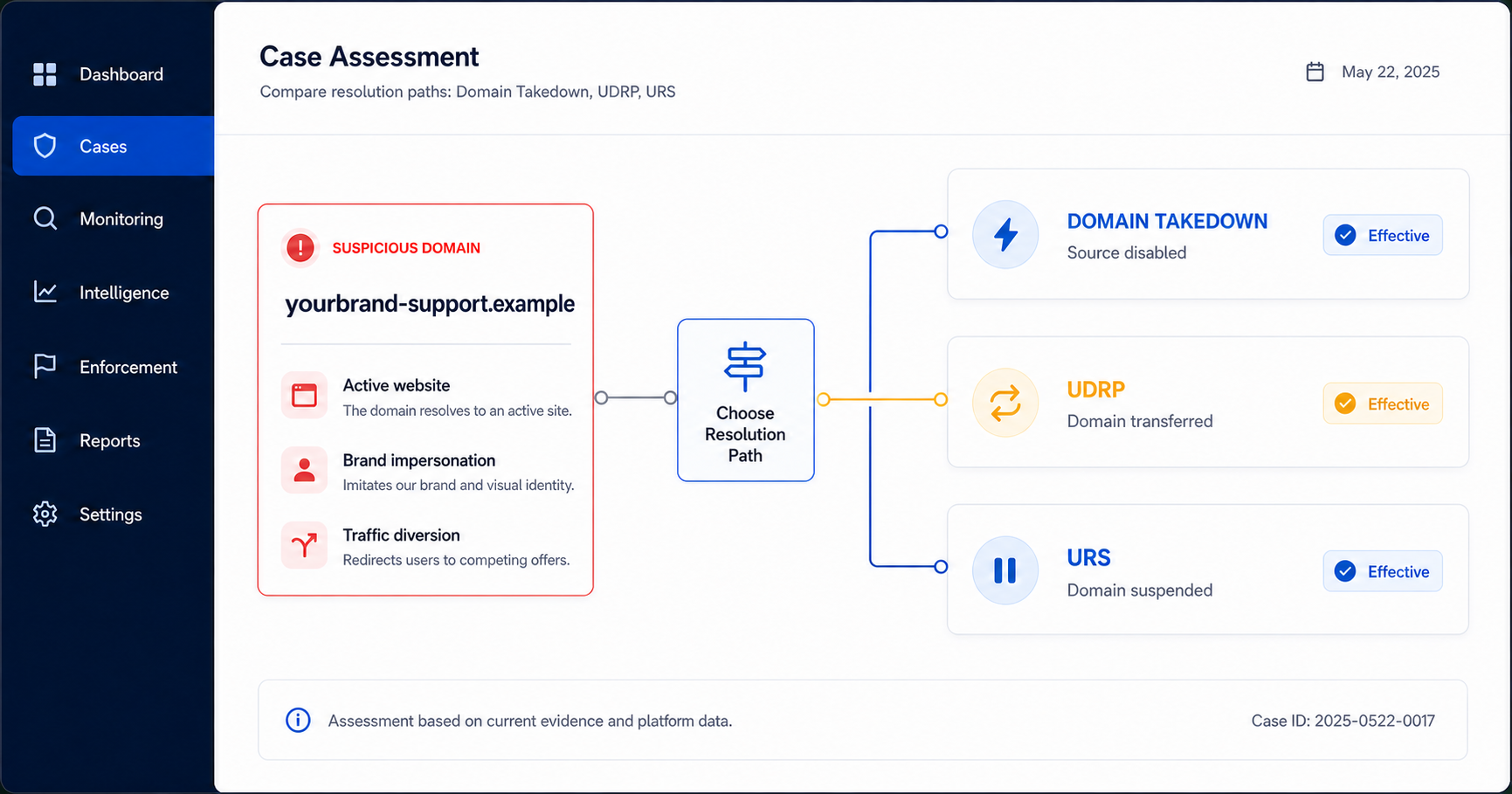
Short answer: active impersonation and traffic diversion may call for operational takedown. A qualifying trademark and cybersquatting dispute may call for UDRP or URS. Similarity alone does not decide the case.
Case assessment comparing Domain Takedown, UDRP, and URS outcomes for a reserved example domain
Side-by-side comparison

Domain Takedown, UDRP, and URS Solve Different Problems

Question
Domain Takedown
UDRP
URS
Primary focus
Active abusive source or customer journey
Qualifying trademark and domain dispute
Clear qualifying domain dispute
Typical evidence
Conduct, visibility, redirects, user impact, rights
Trademark rights and required policy elements
Clear evidence meeting a higher burden
Potential outcome
Source disabled or access disrupted
Domain transfer or cancellation
Domain suspension
Best fit
Impersonation, diversion, mixed active abuse
Recovery or cancellation of a qualifying name
Narrow, clear case where suspension is sufficient
Important limitation
Outcome depends on evidence and responsive parties
Formal requirements and remedy are specific
Does not transfer domain ownership
Route fit

When Each Route May Apply

Operational response

Domain Takedown

Often considered when an active source is impersonating a company, diverting branded traffic, presenting fake support or payment journeys, or creating immediate customer risk.

  • Focuses on observable conduct
  • Can address mixed abuse
  • Includes follow-up and outcome verification
Formal dispute

UDRP

May fit when a trademark owner can demonstrate the required elements and transfer or cancellation is the intended remedy.

  • Requires qualifying trademark rights
  • Assesses the domain under defined policy elements
  • Can result in transfer or cancellation
Narrow formal route

URS

May fit a clear qualifying case where suspension, rather than transfer, is sufficient.

  • Higher clarity threshold
  • Narrower remedy
  • Domain remains registered but is suspended
Decision workflow

Choose the Route From the Required Outcome

Starting with a familiar form instead of the required remedy can waste time while the domain continues intercepting customers.

1

Validate

Confirm the domain, active content, customer journey, visibility, affected markets, and potential harm.

2

Define outcome

Decide whether the priority is urgent disruption, suspension, transfer, cancellation, or a combined strategy.

3

Assess evidence

Map observable conduct and applicable rights to the requirements of each available route.

4

Coordinate

Use the path that matches the evidence and required remedy, with formal proceedings where appropriate.

5

Verify

Track status, confirm the actual outcome, and monitor search for replacement sources.

Outcome matters

Disabling a Source Is Not the Same as Recovering a Domain

Operational takedown

Targets the active source and its ability to serve the harmful journey.

Source disabled or disrupted

UDRP

Determines a qualifying domain dispute under a formal policy.

Transfer or cancellation

URS

Provides a narrower formal remedy for a clear qualifying case.

Domain suspended

Some incidents may justify parallel or sequential action, but each route must stand on its own evidence and requirements. AdFlagger helps assess the case, prepare the evidence, and coordinate the chosen route.

Not Sure Which Route Fits the Domain?

Book a call to review the active use, available evidence, trademark context, urgency, and required outcome.

Book a Call
Frequently asked questions

Domain Takedown, UDRP, and URS Questions

Is domain takedown the same as UDRP?
No. Operational takedown targets an active abusive source. UDRP is a formal domain-name dispute procedure with specific requirements and remedies.
Does UDRP remove a website immediately?
UDRP is not an emergency website-removal mechanism. It determines a qualifying domain dispute and may result in transfer or cancellation after the procedure concludes.
What is the main difference between UDRP and URS?
UDRP can provide transfer or cancellation. URS provides suspension and generally fits a narrower, clear qualifying case.
Can several routes be used for one incident?
Potentially. Active customer harm and a formal domain dispute can require different responses. Each action still needs appropriate evidence and a defined outcome.
Do I need a registered trademark?
Formal UDRP or URS assessment depends on qualifying trademark rights and other required elements. Operational takedown may rely on a broader evidence set, depending on the conduct.
Can AdFlagger assess the route?
Yes. AdFlagger can review the domain, visible conduct, search exposure, evidence, rights context, urgency, and intended remedy before recommending a path.

Request a Domain Route Assessment