
Google Ads Takedown Service
Google Ads Takedown for Branded Search
AdFlagger finds unauthorized brand ads, captures the full click path, coordinates the right complaint route, and monitors whether high-intent traffic returns to your official website.
OFFICIAL
What may be intercepting demand
A Branded Search Should End on Your Official Website
When an impersonator, non-compliant affiliate, fake promotion, or cloaked advertiser appears above the official result, a ready-to-convert customer can be diverted before reaching the brand.

Trademark misuse
Brand terms used in misleading copy or offers.

Redirect cloaking
The visible URL conceals the real destination.

Impersonation
False affiliation, support, login, or official status.

Affiliate hijacking
Brand-bidding, copy, geo, or promotion breaches.

Fake promotions
Unauthorized discounts, bonuses, or claims.

Repeat advertisers
New accounts, domains, and redirects after action.
Takedown eligibility
What Can Be Challenged and What Needs Monitoring First
The right starting point is not “remove every competitor.” It is identifying conduct supported by a policy, trademark, contractual, fraud, misrepresentation, or destination-based route.
There is a concrete violation to document
- Deceptive or confusing trademark use in ad text
- False affiliation, impersonation, or counterfeit offers
- Redirect chains that conceal the real destination
- Affiliate brand-bidding, copy, geo, or promotion breaches
Keyword bidding alone may not be enough
- Trademark keywords are not universally prohibited
- Legitimate resellers may be allowed in some contexts
- A cropped screenshot may not prove the advertiser or route
- No responsible provider can guarantee removal before validation
Policy context: Google Ads Trademarks policy.
Evidence that survives review
One Screenshot Rarely Tells the Whole Story
Ads rotate by country, device, audience, time, and redirect path. A usable case connects the search context to the advertiser, destination, brand rights, and specific rule being relied on.
Keyword, market, language, device, timestamp, ad copy, visible URL, and screenshot.
Tracking URLs, redirects, landing pages, affiliate parameters, and destination mismatches.
Trademark ownership, approved partners, affiliate terms, prohibited claims, and known exceptions.
The outcome that matters
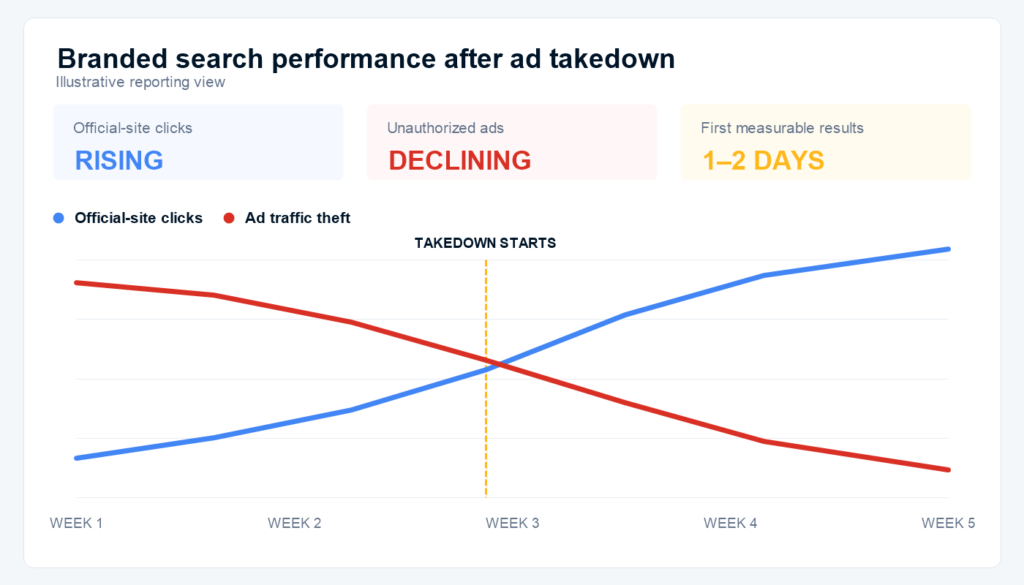
Fewer Hijacking Ads. More Official-Site Clicks.
Complaint volume is not a business result. Reporting should show whether unauthorized ad exposure declines, whether removed advertisers return under new routes, and whether more branded traffic reaches the official website.
Illustrative reporting view; actual results depend on the verified case and market.
Have one suspicious ad?
Find the Right Route Before You File
Bring a branded keyword, screenshot, ad link, final URL, suspicious advertiser, or affiliate rule. We will discuss whether the issue looks like trademark misuse, impersonation, redirect cloaking, affiliate abuse, or a signal that needs monitoring first.
Managed enforcement workflow
Detect, Validate, Enforce, Verify
The process keeps the evidence, complaint route, decision, and repeat violations connected instead of treating each ad as an isolated screenshot.
Detect
Monitor priority brand terms in the markets, languages, devices, and schedules where unauthorized ads appear.
Validate
Confirm the advertiser, ad text, destination chain, brand use, offer, and realistic policy or contractual basis.
Enforce
Coordinate the appropriate trademark, misrepresentation, platform, affiliate, or escalation route.
Verify
Track the decision, replacement ads, recurring advertisers, and branded traffic returning to the official site.
What your team receives
A Clear Case Record, Not a Folder of Screenshots
Brand, legal, performance, compliance, and affiliate teams can work from the same evidence and status trail.
- Priority keyword and market monitoring scope
- Evidence tied to the live ad and final destination
- Advertiser- and domain-level case organization
- Complaint and enforcement coordination
- Repeat-ad detection after apparent removal
- Reporting focused on official-site click recovery
Proof in practice
See How a Real Ad-Hijacking Case Was Handled
RocketPlay’s case study shows the operational connection between monitoring branded queries, identifying hijacking patterns, coordinating action, and protecting the official acquisition path.
RocketPlay case study
From recurring ad hijacking to a managed enforcement loop
Frequently asked questions
Google Ads Takedown FAQ
Can every competitor ad using our brand keyword be removed?
No. Keyword bidding alone is not automatically prohibited. The viable route depends on the ad copy, confusion, advertiser identity, destination, market, trademark rights, and any applicable partner terms.
What should we send for an initial review?
Send the branded keyword, country, device, approximate time, screenshot, ad or tracking link, and final destination if known. A short explanation of why the ad is unauthorized is helpful.
How quickly can a takedown happen?
Timing varies by evidence quality, violation type, platform review, market, and whether escalation is required. AdFlagger can move quickly on evidence capture and route selection, but does not promise a fixed platform decision time.
Can you detect ads that appear only in certain countries?
Monitoring can be scoped by priority markets, languages, devices, schedules, and brand queries. The scope should follow where the business risk and customer demand actually exist.
What happens if the advertiser returns?
Repeat ads can be linked to previous advertisers, domains, redirects, creative patterns, and complaints. This makes recurrence part of one enforcement record instead of a new case every time.
Do you also handle fake websites behind the ads?
Yes, when the destination itself creates a separate domain, impersonation, fraud, or content-removal issue. AdFlagger can review whether Ads Takedown, Domain Takedown, or another route fits.
Show Us the Unauthorized Ad