
How Lookalike Domains Divert Customers
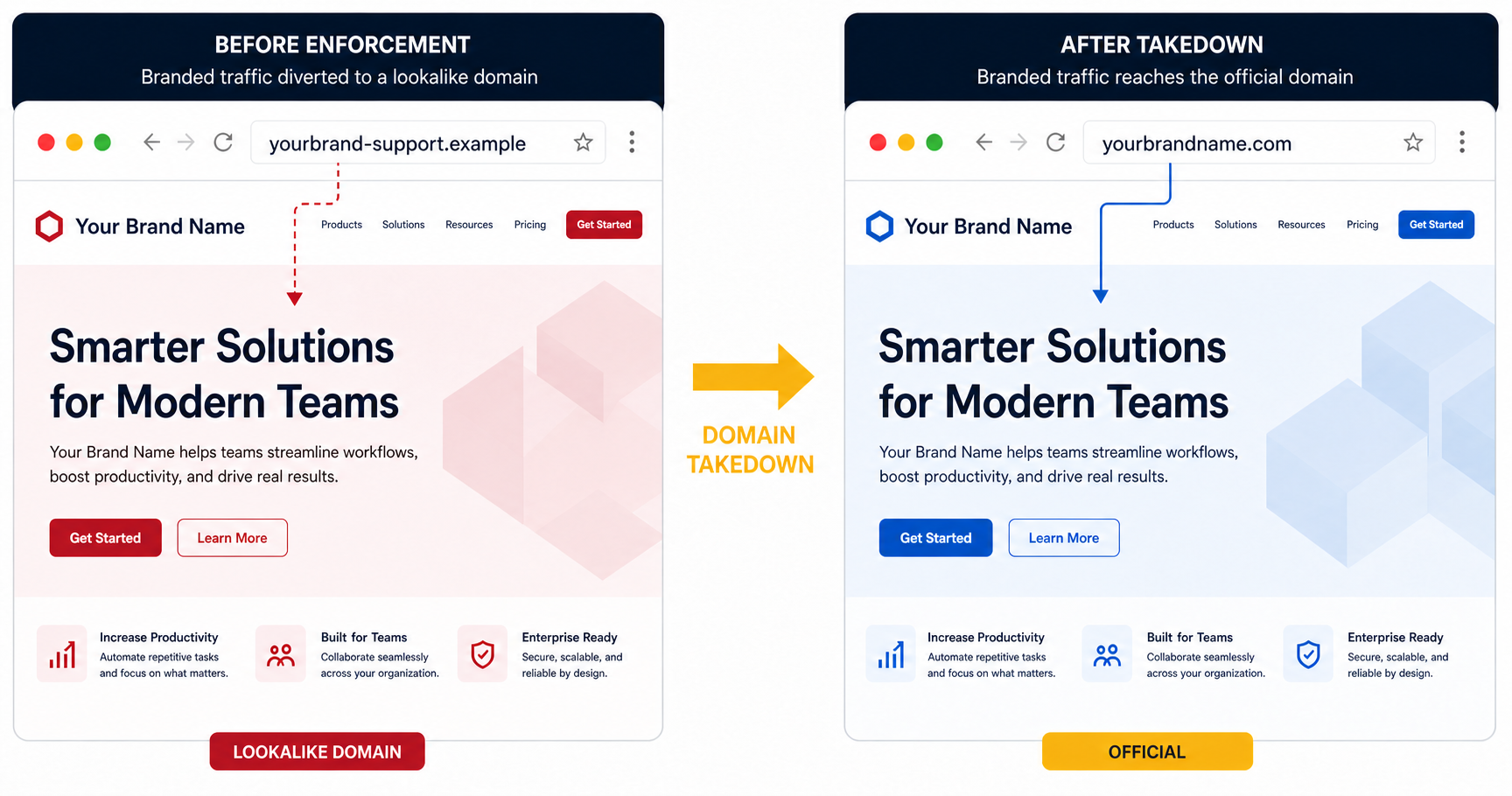
Typosquatting domains exploit small differences in a familiar web address. A transposed letter, added word, different extension, or visually similar character can send a high-intent visitor to the wrong destination before the official brand receives the click.
The risk is not limited to people typing an address incorrectly. Lookalike domains can surface in branded search, ads, support journeys, shared links, apps, and redirects.
What Typosquatting Domains Can Look Like
The strongest examples remain readable as the brand at a glance, especially on mobile screens, in ads, or inside a long URL.
Transposed characters
Two neighboring letters exchange positions while the overall word still looks familiar.
Added or repeated character
A duplicated letter is easy to miss when a customer scans rather than reads the full address.
Hyphen or added word
Terms such as login, support, bonus, app, or a market name can imply an official function.
Alternative extension
A familiar brand name appears under another top-level domain or country extension.
Visually similar character
A Unicode or accented character can resemble the expected letter in common fonts.
Intent modifier
The domain targets a customer who is looking for help, access, payment, or an offer.
How a Lookalike Domain Intercepts Branded Demand
Intent already exists
A customer wants the official website, login, support team, app, promotion, or local service.
The wrong address appears
The user mistypes the URL or chooses a lookalike result, ad, link, or public profile.
Trust is borrowed
The source uses familiar naming, design, offers, or support language to keep the visitor moving.
The brand loses the journey
The visit converts elsewhere, reaches an unsafe action, or creates acquisition and support costs.
The Problem Often Appears in Search and Customer Data
No single chart proves typosquatting, but combined signals can show that branded demand is reaching unfamiliar sources.
Unknown SERP domains
New sources appear for brand, login, support, review, offer, or market queries.
Branded CTR pressure
Official clicks weaken while impressions or overall brand demand remain stable.
Paid search pressure
The company spends more to defend branded queries and familiar customer journeys.
Customer reports
Users mention unfamiliar pages, payments, downloads, phone numbers, or account forms.
Illustrative exposure review
Priority rises when similarity is combined with visibility, misleading conduct, or an actionable customer journey.
Typosquatting, Cybersquatting, and Website Impersonation
Typosquatting
A lookalike name exploits a likely typing error or visual similarity. The relevant risk depends on use and exposure.
Cybersquatting
A qualifying trademark and domain-name dispute may support a formal procedure such as UDRP or URS.
Website impersonation
The website creates a misleading connection through design, claims, support, offers, forms, or a copied customer journey.
From Detection to Verified Domain Takedown
Discover
Identify suspicious domains through branded journeys, monitoring, and customer reports.
Validate
Confirm what the source shows, where it sends visitors, and which markets can reach it.
Preserve
Record relevant pages, redirects, search exposure, dates, and supporting brand evidence.
Enforce
Coordinate the appropriate evidence-led takedown or formal domain dispute route.
Verify
Track the outcome, check search visibility, and monitor for replacement domains.
The objective is not a report. It is a verified reduction in sources competing for branded demand.
Is a Lookalike Domain Using Your Brand?
Book a call to review the domain, customer journey, search exposure, and whether a removal route may apply.